
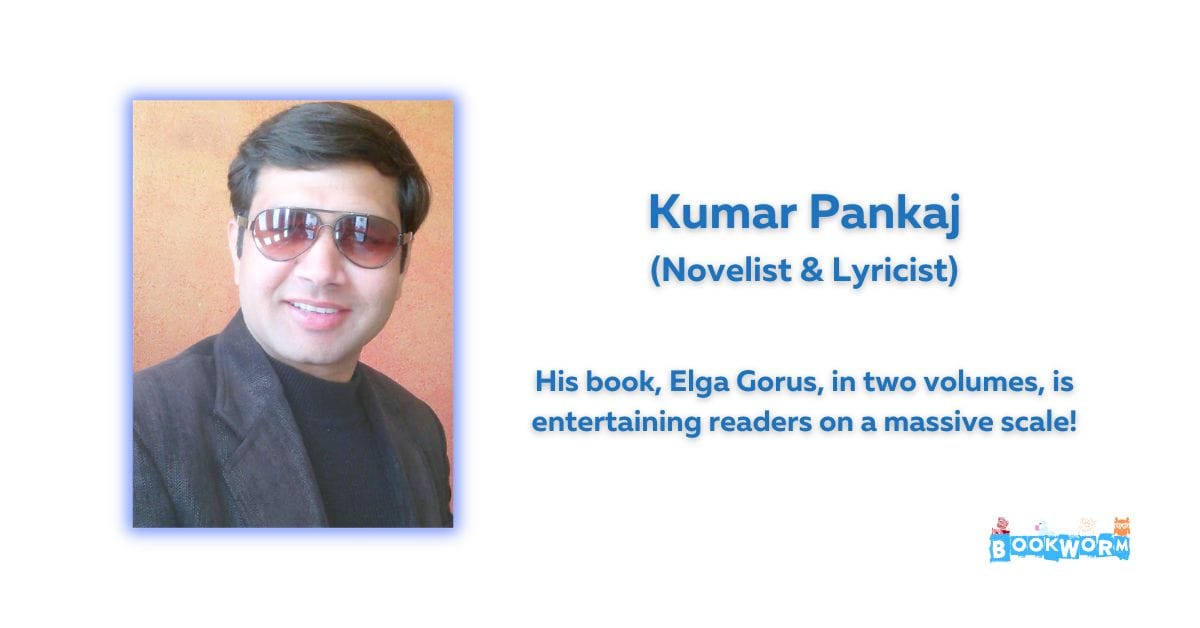
The most revealing thing about a writer is not always what he writes. Sometimes, it is what he chooses not to write. In a literary marketplace increasingly dominated by familiar formulas, predictable emotional arcs, and commercially proven themes, Kumar Pankaj’s journey as an author becomes fascinating precisely because of the risks he has chosen to embrace. When I first encountered his name, it was not through an interview, a literary festival, or a social media campaign. It was through Elga Gorus, a two-volume fantasy saga, that has recently attracted considerable attention among Hindi readers. My initial reaction was one of curiosity. Here was a contemporary Hindi novelist attempting something that many writers actively avoid: building a vast, original, mythological universe in an era when realism and relationship-driven fiction dominate the conversation. By the time I had explored the book, its reception, and the author’s broader body of work, it became increasingly clear that Kumar Pankaj represents something more interesting than a successful novelist. He represents a writer attempting to redefine what contemporary Hindi fiction can aspire to become.
The first thing that emerges while examining Kumar Pankaj’s literary career is its diversity. Unlike many writers who remain associated with a single subject or genre, his bibliography reflects a wide range of interests. He writes songs, poems, essays, articles on diverse subjects and more. You cannot confine Kumar Pankaj to one, two or even three roles. It shows how diversity might have played a crucial role in shaping the current success of the novel Elga Gorus, which comes in two volumes.
This diverse background of the novelist becomes particularly important when assessing Elga Gorus. The novel did not emerge from nowhere. It appears to be the culmination of years spent observing different kinds of narratives, audiences, and subjects. What makes the transition remarkable is that instead of pursuing the relatively secure path of popular contemporary fiction, Kumar Pankaj chose to invest his creative energies in fantasy, mythology, mystery, and world-building. This decision is more significant than it may initially appear. In contemporary Hindi publishing, romance and relationship-centred fiction often dominate younger readership segments. Such books possess clear commercial advantages. Their themes are immediately recognisable, their emotional structures are familiar, and their audience is already established. Fantasy, especially original fantasy rooted in a completely new mythology, presents a far greater challenge. It demands patience from readers and courage from writers. Kumar Pankaj’s willingness to embrace that challenge says a great deal about his literary priorities.
Perhaps the most distinctive aspect of Kumar Pankaj as an author is the scale of his imagination. Imagination is often praised casually in literary criticism, but in his case, it deserves serious attention. Most writers imagine stories. Kumar Pankaj imagines ecosystems. The world of Elga Gorus is not constructed around a single adventure or conflict. It is built around myths, forgotten histories, mysterious races, ancient texts, hidden knowledge systems, symbolic landscapes, and elaborate cosmological structures. Several reviewers have highlighted precisely this quality, noting that the novel creates not merely a fantasy setting but an entire mythological framework capable of sustaining multiple narratives. Critics have repeatedly pointed to the novel’s ambitious world-building and its attempt to revive large-scale imaginative fiction within Hindi literature.
What is particularly striking is the confidence with which he approaches this imagination. Many writers introduce unusual ideas cautiously, almost apologetically. Kumar Pankaj does the opposite. He fully commits to his fictional universe. The premise itself demonstrates this confidence: a mysterious sacred text engraved upon thousands of wax tablets, ancient scripts, forgotten civilisations, strange races, mystical beings, and elaborate quests driven by symbolic objectives. The world is intentionally grand, mysterious, and layered. Readers are not eased into it gradually. They are invited to immerse themselves in it completely. The official descriptions and reader responses consistently emphasise this sense of scale and wonder.
His writing style reflects the same expansive instinct. One of the recurring observations across reviews is the visual quality of his prose. Kumar Pankaj writes like someone who sees stories before he writes them. Locations are rarely described as static backgrounds. They become active participants in the narrative. Caves, forests, deserts, hidden settlements, mysterious structures, and strange territories are rendered with remarkable clarity. Reviewers have frequently noted the cinematic quality of the imagery, suggesting that many scenes seem naturally suited for visual adaptation. The descriptive strength of the writing allows readers to inhabit the world rather than merely observe it. This ability to generate vivid mental images is one of the qualities that distinguishes his work from more conventional contemporary fiction.
Yet imagination alone does not explain the growing interest in Kumar Pankaj’s work. Equally important is his apparent understanding of an overlooked readership. For years, many young Indian readers interested in fantasy, mythology, speculative fiction, and immersive world-building have turned almost exclusively toward English-language literature. Their reading habits were shaped by global franchises and international publishing trends. Hindi literature, despite its richness, offered relatively few contemporary works operating on a comparable imaginative scale. Kumar Pankaj appears to have recognised this gap and deliberately positioned his work within it. Rather than competing directly with established trends, he has attempted to create something that many readers did not realise they were missing. This may ultimately prove to be one of his most important contributions.
The reception of Elga Gorus suggests that this strategy has found an audience. Goodreads ratings for both volumes have remained notably strong, with readers responding enthusiastically to the novel’s mythology, mystery, and world-building. User engagement on platforms such as Goodreads is often regarded as an important indicator of reader investment because it reflects not only sales but active participation in discussion, reviewing, and recommendation. Academic research on Goodreads has similarly noted the importance of reader engagement in understanding literary popularity and influence. While popularity alone does not determine literary value, it can indicate whether a work has successfully connected with its intended audience. In the case of Elga Gorus, the evidence suggests that Kumar Pankaj has succeeded in attracting readers who were actively seeking large-scale imaginative fiction in Hindi.
That said, it’s only fair to talk about the hurdles readers might face. The very things that make Kumar Pankaj’s writing stand out can also make it a bit of a climb. Because he pours so much energy into building this massive world, the story can sometimes feel incredibly dense. With an abundance of characters, deep lore, and sprawling landscapes, it asks a lot of your attention. Some readers might find the sheer complexity a bit overwhelming, or feel like the book slows down just to soak in the atmosphere. But honestly, these challenges only exist because his vision is so massive. Anyone trying to build a whole new universe runs into this, and at the end of the day, it’s a much better “problem” to have too much imagination than too little.
Looking ahead, Kumar Pankaj occupies an intriguing position within contemporary Hindi literature. He has already demonstrated that there is a readership willing to engage with ambitious fantasy fiction in Hindi. He has shown that younger readers need not abandon their language to experience large-scale imaginative storytelling. More importantly, he has challenged assumptions about what kinds of narratives Hindi literature can successfully support. Whether Elga Gorus ultimately becomes the foundation of a larger literary universe or remains his defining work, it has already established him as a writer willing to expand the boundaries of contemporary Hindi fiction.
In the final analysis, Kumar Pankaj appears less like a conventional novelist and more like a literary explorer. His career reflects curiosity, experimentation, and an unusual willingness to pursue difficult creative goals. He has written across genres, subjects, and forms, but his most significant achievement may be his effort to reclaim imagination as a central force within modern Hindi literature. At a time when many writers compete within familiar territories, Kumar Pankaj has chosen to venture into unexplored landscapes. Whether one approaches him as a fantasy writer, a myth-maker, or a literary risk-taker, one thing becomes clear: he is not content merely to participate in the existing conversation. He is attempting to change it. And in contemporary literature, that is a far rarer ambition than it should be.
Analysis by Mukesh Kumar for BookWorm Reviews
..