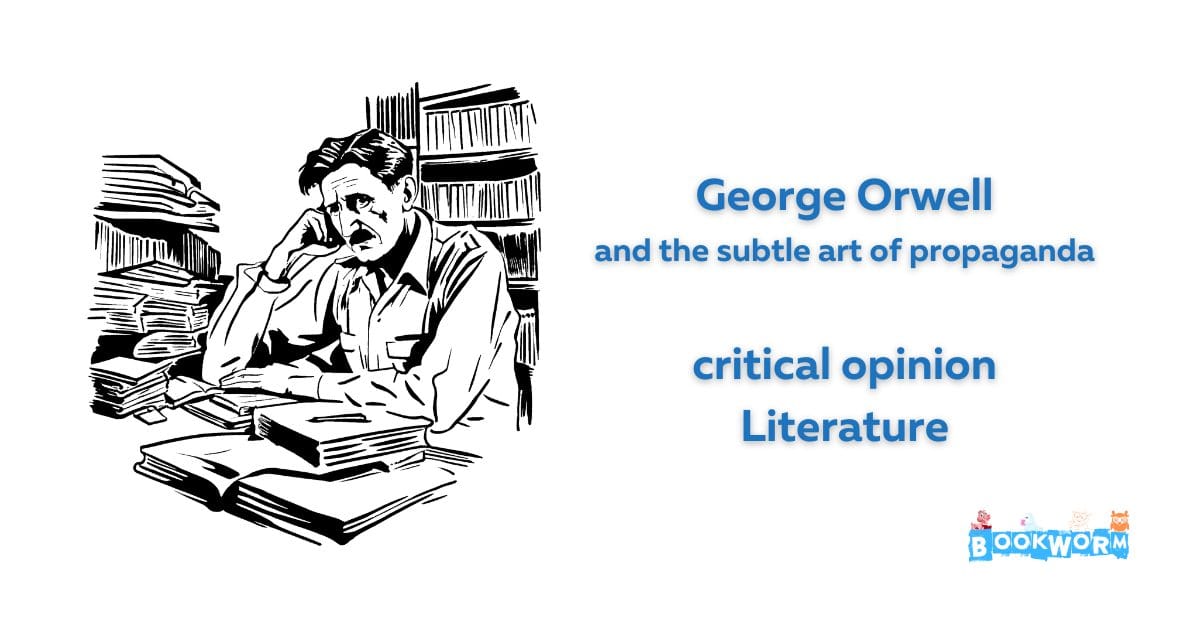
Few writers in modern literary history have achieved what George Orwell did. Many authors craft memorable novels; some write influential political essays; a select few become symbols of intellectual resistance. Orwell belongs to that rare category whose literary creations have transcended literature to enter everyday vocabulary. Terms like “Big Brother,” “doublethink,” “thoughtcrime,” and “Orwellian” no longer remain confined to fiction but serve as instruments through which contemporary society interprets politics, media, governance, and propaganda. Yet Orwell’s greatness does not lie merely in predicting totalitarianism’s dangers; his enduring significance emerges from his remarkable understanding of propaganda’s mechanisms, psychology, and devastating capacity to alter human consciousness. Unlike political writers who merely condemn propaganda, Orwell dissects it, reveals its anatomy, and demonstrates how literature can become a productive force against ideological manipulation.
To understand Orwell properly, one must recognise him as a literary diagnostician whose works function like medical reports on modern civilisation’s diseases. While other writers described symptoms, Orwell investigated causes. The twentieth century, perhaps the greatest age of organised propaganda, saw fascism, Nazism, Stalinism, colonialism, and even democratic governments increasingly rely upon controlling narratives; the modern state discovered that controlling language often proved more effective than controlling armies. Orwell witnessed these developments firsthand, and his experiences during the Spanish Civil War, later documented in Homage to Catalonia, profoundly shaped his understanding of political deception. Unlike many intellectuals of his time, he refused to romanticise political movements merely because they aligned with his ideological preferences, observing how propaganda operated among enemies and allies alike. This intellectual honesty distinguished him from contemporaries whose political commitments often blinded them to uncomfortable truths.
His masterpiece, Animal Farm, remains one of the finest literary explorations of propaganda ever written. At first glance, a simple fable about farm animals overthrowing their human master, beneath its simplicity lies an extraordinarily sophisticated political allegory. The pigs, particularly Napoleon and Squealer, understand a fundamental principle: whoever controls language controls reality. The gradual transformation of the Seven Commandments illustrates how propaganda functions not through dramatic lies but subtle modifications, as the famous commandment “All animals are equal” eventually becomes “All animals are equal, but some animals are more equal than others.” This absurd statement captures propaganda’s essence: it does not seek logical consistency but psychological acceptance. Orwell’s brilliance lies in exposing this process through narrative rather than theoretical exposition; readers witness propaganda in action, observing how repeated distortions become accepted truths. His method differs significantly from that of political theorists, teaching through storytelling rather than argumentation.
Want to read Orwell’s Essays? Learn: How to Study Essays?
The same concern reaches its highest expression in Nineteen Eighty-Four. If Animal Farm examines revolutionary ideals’ corruption, Nineteen Eighty-Four investigates totalitarian control’s ultimate consequences, presenting perhaps the most terrifying vision of propaganda ever conceived. The Party does not merely suppress information; it manufactures reality itself. The Ministry of Truth’s purpose is not to preserve historical records but to alter them continuously: newspapers revised, past predictions modified, historical facts disappearing, memory becoming subordinate to political necessity. Here Orwell introduces “doublethink,” the ability to hold contradictory beliefs simultaneously while accepting both as true, representing propaganda’s greatest achievement. Successful propaganda does not merely persuade people to believe lies; it destroys their ability to distinguish truth from falsehood altogether. When Winston Smith writes that freedom means the freedom to say that two plus two make four, Orwell identifies the ultimate battlefield of political life as reality itself. This insight explains why Orwell remains startlingly relevant in the digital age, where social media algorithms, information bubbles, selective reporting, manipulated images, and manufactured outrage perform similar functions; the methods have changed, but the objectives remain remarkably familiar.
Reducing Orwell to a prophet of dystopia, however, would be a serious misunderstanding. Beneath his criticism of propaganda lies a profound belief in productive literature, which does not advocate a different ideology but encourages intellectual independence, teaching readers how to think rather than what to think. This distinction is crucial: many political novels attempt to convert readers; Orwell attempts to awaken them. Compare Orwell with Soviet Socialist Realist writers whose works served explicit ideological purposes, presenting predetermined conclusions where characters become vehicles for political messages and complexity is sacrificed for certainty. Orwell resists this temptation. Even when his political positions are clear, he preserves ambiguity, contradiction, and human complexity: Winston Smith is not a flawless revolutionary hero, and Boxer in Animal Farm is not merely a victim. These characters possess emotional and psychological depth, their humanity preventing the novels from degenerating into simplistic political pamphlets. A useful comparison may also be made with Huxley’s Brave New World: both examine authoritarian societies, yet Huxley’s dystopia is built upon pleasure and distraction, Orwell’s upon fear and surveillance. In Huxley’s world, citizens surrender freedom because they are entertained; in Orwell’s, because they are terrified. Modern societies often contain elements of both visions, demonstrating Orwell’s enduring relevance, for while many dystopian writers create imaginative futures, Orwell identifies enduring psychological mechanisms that transcend particular political systems.
Orwell’s essays further illustrate his commitment to productive literature. In works such as Politics and the English Language, he argues that political dishonesty frequently depends upon linguistic corruption: vague phrases, inflated diction, and meaningless abstractions enable intellectual manipulation. This essay remains one of the twentieth century’s most important discussions of language. For Orwell, clear writing is not merely an aesthetic preference but an ethical obligation; when language becomes imprecise, thought becomes imprecise, and propaganda flourishes. This explains why his prose remains remarkably accessible. Unlike intellectuals who employ complexity as a marker of sophistication, Orwell valued clarity: his sentences are direct, his vocabulary generally simple, yet beneath this apparent simplicity lies extraordinary intellectual precision. Students of literature often overlook this achievement, but writing simply is far more difficult than writing obscurely. Orwell’s style reflects his democratic vision of literature, believing important ideas should remain accessible to ordinary readers; literature should illuminate reality, not conceal it behind unnecessary complexity. His influence upon contemporary political writing is therefore immense; journalists, essayists, historians, and commentators continue to draw upon Orwellian concepts because they provide powerful tools for analysing modern political culture.
Yet Orwell’s legacy extends beyond politics. At its core, his work asks fundamentally human questions: What happens when truth becomes negotiable? What remains of individuality under immense social pressure? Can memory survive institutional manipulation? How does power reshape human relationships? These questions ensure that Orwell remains not merely a political writer but a literary artist of the highest order. His novels succeed because they combine intellectual seriousness with emotional resonance: readers remember Winston Smith’s loneliness, Boxer’s loyalty, Julia’s rebellion, and the animals’ shattered hopes. The political message gains power because it emerges through lived human experience. That is productive literature’s hallmark: it informs without preaching, educates without lecturing, challenges without alienating. George Orwell’s greatest achievement may therefore be his demonstration that literature can resist propaganda without becoming propaganda itself. In an age increasingly characterised by competing narratives, ideological polarisation, and information overload, this lesson remains invaluable. The finest literature does not provide comfortable answers; it sharpens perception, strengthens scepticism, and cultivates intellectual independence. Orwell understood this truth better than most twentieth-century writers, and his works endure because they remind readers that freedom ultimately begins with the courage to think clearly, speak honestly, and question relentlessly. In that sense, Orwell was not merely chronicling his own age’s dangers but preparing future generations for theirs, and perhaps that is why, decades after his death, George Orwell remains not only relevant but indispensable.
Anand Shiv J for BookWorm Reviews
.